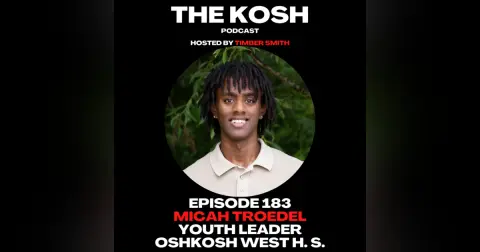
0:05
Hello and welcome to The Kosh.
I'm your host, Timber Smith, and the Kosh is a podcast that spotlights people who've had an association with the Kosh in the surrounding Fox Cities region.
0:22
Also, you know what the Kosh is?
It's the people's podcast.
Hey Kosh listeners, how are we doing today?
It's another fantastic weekend.
Wow.
We're still stuck in winter, but it's Black History Month, so I'm just going to be like, it's fantastic.
0:39
It's fantastic to me.
All right, I do.
I do get geeked about Black History Month.
Black History Month is that time of year for me that I get the opportunity usually to go out and get very, very involved.
I, I get the privilege of getting a lot of requests and going to go speak in front of different things or participate in different things and just be representative of our community.
1:02
And for every person that's ever asked or thought that I was worthy, I appreciate you.
Thank you for including me in your Black History Month celebrations.
It's it's it's important to me.
All right, Kosh, listeners, before we go too much further, let me just say this that, and I think you've heard me say this a couple episodes now, but I'm going to keep saying it because we have a sponsor and that sponsor is Timber ties.
1:31
If you don't know, Timber has a business and that business is the wooden bow tie business.
And so I need you to check it out is pretty awesome.
We do have a website, we have a Facebook page.
So go check out timber ties on Facebook.
And then also our the website istimber-ties.com.
1:51
They're bold, they're distinguished, they're elegant.
Check it out.
If you've got that special occasion that you need to go rock something different or you need, or if you're going to that event and you you need a conversation piece, throw on a timber tie.
I promise you it'll, it'll strike up some interesting conversations.
2:10
OK, so gosh, there's let me just say this.
I am really, really excited about this conversation today.
This particular guest, I've been lucky enough to kind of watch some of the things that they're doing in the community and they are creating impact.
2:29
And I always love the opportunity to give voice to our young people.
I don't think we always get enough opportunity to hear the, the intelligence and the, the thoughts of our young people.
2:45
But they be they, they, they're aware, they're watching things and they have thoughts on things.
And so this particular episode during Black History Month, we are about to give some very crucial voice to somebody in our community that I am honored to have sit in the chair.
3:04
But before we get to that, let me just say this.
And I think you know what I'm going to say, and that is this.
I don't know how we continue to get these amazing, amazing guests.
And guess what?
3:20
This week is not any different.
So without any further ado, this week's guest is Micah Tradel.
Did I get it right?
Yes, yes.
OK, I I wanted to say it a different way but I didn't slaughter the name.
3:40
Yeah.
All right.
How are we doing today, Micah?
I'm doing amazing.
Very grateful to be here.
I'm I'm very excited.
You're sitting in the chair.
Thank you.
All right, you ready to jump in?
I'm always ready.
OK, he said.
Always ready.
OK, Micah, Well, can you please share a little something about yourself and your relationship with the Kosh and the surrounding Fox City region?
4:03
Yeah, so I moved to Oshkosh 16 years ago.
I was 11 months old.
So I've I've grown up here.
Right now I'm a senior at Oshkosh West and I serve as the president of the Black Student Union.
But I think throughout high school I've kind of dug into the kosh and really became involved.
4:21
So it is.
It is a place I plan to stick around.
Yeah, you, you, you're trying to hang out for a minute.
Yeah, right.
OK.
You said you're a senior.
Yeah.
How was your journey here in the cosh going through our school system?
4:37
It was interesting.
It was.
So I like to tell people I've had the most unique experience in the Oscars public schools, anybody that I've met, because I went from like being one of four black students in my grade at Carl Traeger Elementary and Middle School to go into Oshkosh W once again being a very small minority.
5:00
But then very quickly becoming connected with some very influential people who gave me a lot of really, really cool opportunities to make an impact and make a change in a way that I just haven't seen anybody else get get the opportunity to do.
I feel that what I've noticed personally, I got an opportunity yesterday and this was just yesterday to go be part of the Read Your Heart Out program over there at Menominee.
5:28
And my observation is this.
When I looked around and and you know, my daughter went through the Oshkosh school system.
You know, she went to Washington, she went to Webster, she went when Webster was Webster, she went to North right.
And those numbers.
5:43
Now there are a lot of students of color.
Yeah, like more.
I swear to God, every room.
And I read to three or four different classes and I read to three first grade classes and one second grade class.
And I was looking at, you know, the, the demographic makeup, or at least the appearance of the demographic makeup.
6:04
You know, I don't, I can't say for sure, but I was blown away.
And I was like, wow, yeah, the it's changed.
Yeah.
I mean, we're very quickly becoming a more diverse area.
I think in my experience, I think it's a little bit different being on Sorry, I'm horrible at directions the side of town that trackers on all the way out there by 20 is it and just the make of the people who live in that area.
6:30
But I yeah, West side, yeah.
Or that's what they call it, the West Side, yeah.
OK, I don't know my directions, I'm sorry.
But yeah.
I will also say though, like that creates, it helps you in a way definitely to grow up in that environment and learn how to operate in those spaces.
6:47
What do you mean?
Being a black person operating in almost all white spaces is a very unique thing and something that I think a lot of people don't get the opportunity to learn that skill early on in their life.
So I do think as difficult as it may have been at times, I'm very fortunate to have experienced that.
7:04
So some early.
I can relate to that.
Yeah, big time.
But before we we go too hard, I want to go back a little bit here and ask a little bit more about like, Micah, what you doing in high school?
I mean, what you what you up to you, you, What are we studying?
7:20
Do we do some sports?
What else?
Do we participate in the community?
Who's Micah?
So I'm part of many clubs at our school.
Sources of strength.
Why to why?
Like there's a plethora of clubs.
I'm also a captain for our varsity basketball team.
7:36
This past year I was very fortunate to run cross country with a friend of mine who needed some assistance, just being able to navigate the routes and stuff like that.
So that was a really fun experience.
But I would say if if any of you would like to hear about it, my favorite course is English, something that I'm very passionate about personally.
7:54
So captain of the basketball team you got?
Skills.
A little bit, a little bit little.
Bit, little bit.
OK, what's our what's our position?
I play guard, OK Guard so I mean.
Do wait, do we got a jumper or or is it the candles?
How do we get down you?
8:10
Know it's it's really a jumper it's really a jumper.
I don't, I'm a skinnier guy so it's not always finishing but I don't miss so yo.
You said it like.
That yeah, miss.
Yeah.
I mean, I appreciate that.
8:25
Yes, Sir, last night.
We don't need to talk about last night though.
That was on the next.
Oh wait, who did y'all play?
We played Kimberly, it was our senior night on the next game, that one in the past you.
Said we don't even want to address.
8:42
It don't even need the don't even need to go there all.
Right.
Mike, what about some of these other clubs that you're involved in?
And in your introduction you started off with being BSU president.
So I want to know about some of these other clubs and what do they do, how you might be involved.
9:00
And then I want to know what is, you know, it is Black History Month.
What is our BSU doing or up to?
Yeah, So I would say the the biggest involvement for a club for me is BSU.
And for those of you aren't aware of what BSU is, I think it's what we do is Bsus.
9:18
We foster a space where our black students can feel comfortable.
So like that comes from our group meetings, that comes from meeting with our administrators to create a tangible policy change that comes from holding events after school.
Like it comes in a pleasure of ways, but that is the the biggest way or the biggest thing that we do for Black History Month.
9:39
We're holding gallery walk.
So it's actually a really interesting event where you can come in and there's going to be a short program in the middle at the beginning, sorry.
And then you can walk around in our cafeteria and we have like different figures from black history posted up all over with like biographies, information about them, stuff like that.
9:58
And then students will be standing by them presenting to you and to let you know a little bit of inside information, something that we did.
So students were learning from all this as well, is each one of the things that you see around students put together.
So like they had to go through, do research, cite their sources so that we could make sure it was all true, like that type of stuff to put it all together so they're really able to present on it.
10:21
Nice.
OK.
And where is this gallery walk happening?
Oshkosh West.
Oshkosh, W OK.
February 20, Seventeenth.
Open to the public yes nice OK why English and so and I and I go to that because you know out of all the subjects to say you.
10:42
Know why English?
I would say there's really three reasons.
The first one is it's just the one that came most natural to me, right?
Like I think human nature, love what you're comfortable doing that that's a big thing.
The second piece is that I love to be, I love entertainment and to me, books are really good form of entertainment.
11:03
So reading just became something that I I thought myself very passionate in.
And then the last one is I like to talk.
So like I always feel like I have a message to give people and writing became my way to do that.
So whether that be writing a speech, writing a paper for class, or something as simple as writing an e-mail, where all things that I found myself enjoying to do since I really started to dig into my English classes, gain all the knowledge that I could, and that love just started to develop from there.
11:34
You very much are in a trajectory of growth and development, right?
Who are The Who are some of those mentors is helping?
OK.
I'll lead with there's a lot.
So if you're listening and I don't mention you, you're still incredibly valuable to me, He.
11:50
Said no disrespect.
No disrespect, but the first one I would say is Mr. Anthony Miller, the director of Community Engagement Equity was our school district.
I think I first met him by like the beginning of my sophomore year of high school when he first came to the district.
12:06
And from there, I mean, he's just played a pivotal role in helping me develop and go along this path.
Other person that I would say is Doctor Coleman, another person that works for the Hot Sketch Area School District, who kind of the same way has really helped me develop and just been in my corner supporting me and providing those opportunities for growth.
12:25
That's huge.
It is, it is, and they're both really funny.
Oh.
That that's the biggest thing is like when you can find mentors that are helping you grow, but also you find joy just in being around them like.
That's what mentorship was supposed to be.
12:41
You know, there's supposed to be some guidance.
If there's hard things that need to be said, then some of that happens.
But it should be centered in joy.
Exactly.
No ifs, ands or buts about that.
I feel that.
I think it's just something we're getting away from.
Say more.
12:57
So what I've found is that a lot of people who are trying to mentor now, and I've even seen myself fall into this a little bit, but is that it's hard to look at somebody, see yourself in them, see how great they can be, and then be willing to see them not succeed at something and be happy.
13:18
But at the same time, it's like, yes, it is a time to get on them and tell them what they need to be doing better, help them get there.
But like if you're not happy through that, they're not going to want to be around you.
They're not going to be around you.
So you won't have that influence anymore.
You, you have to be the humble mentor.
13:36
Exactly.
The supportive mentor no matter what exactly.
Maybe the ride or die mentor.
I would say that.
You like that?
I like that.
All right.
What are we thinking about for the future?
What we, what we going to do?
Well, I know I'm going to a four year university to study education and then pursue Graduate School.
13:56
And directly after that I'm not 100% sure on the college yet.
You know, I'm thinking.
What's in the what's you're a senior now you what's in the front running?
Give me top three.
Top three are going to be Morehouse, Madison, and UWL.
14:12
OK.
So I I'm still waiting on some acceptances, some scholarship stuff, like some of those pivotal pieces to make that choice.
But that.
That's a wide range.
Yeah, it is.
But what's crazy about it is there is not a single one of those where I wouldn't be happy going there.
So all three of those schools, like, I don't really think there's a bad option.
14:32
Nah, so.
Not at all.
Exactly.
They're all fire options.
Yeah.
You know, I applied to Morehouse, OK?
And I did get in, Yeah, but the, the, the financial aid didn't come right now.
That's that's the thing about Morehouse is it's my dream school.
14:49
But if those scholarships don't come through, it's it's not happening.
You, you got to keep.
You got to keep a real, you know, point of view when when chasing the the college dream.
Yeah, I mean.
What do we, what do we want to go to school for 'cause you didn't hesitate, you were like 4 year period, yes, now what?
15:12
Now we we get 4 years.
Exactly.
I want to go to school for education, OK?
You did say.
That yes, I want to either be English or social studies education.
I'm not 10,000 per sure sure sure yet on which one because I love them both so much that I it's hard to pick between the two, but I go ahead.
15:32
Do you have educators in your life?
And the reason I asked this, I mean, you mentioned your mentors and they are under the umbrella of or some of your mentors under the umbrella of educators.
But I've, I, I don't know, I've, I've noticed this pattern that educators create educators.
15:54
Like there's so many times you meet someone who's a teacher and then one of their parents or both their parents might have been teachers or at least worked within the educational system.
Do you have that kind of influence going on?
So I got like three of them from over my career school.
16:10
So first of all was my eighth grade English teacher, misses Kerry Van OS, and she never once said a word to me about becoming an educator, but through her greatness and what she was able to do, I saw how meaningful the impact of educator could be.
16:26
So that planted I see in the way back in my head where I wasn't even thinking about it, but it just taught me what that impact could be.
The second one was Mr. John Burke.
So he's my history.
He was my history teacher in my sophomore and junior year.
And he's one of those classes where like you're going to struggle, like he's not going to.
16:44
He has a high bar and he expects excellence out of you every single day.
And at first I didn't rise to it.
Like I was just like, OK with being below.
But then he really challenged me and I started to rise to it.
And again, I saw what it could really be.
And then my English teacher right now.
So I'm going to share a quick story the other day.
17:02
I'm the type person.
I'll ask a question at any time.
Like if I don't know the word that you just use, I'm I'm going to raise my hand and ask you what it means.
So I did exactly that, right?
Like I raised my hand, I asked him what a word he used meant.
He explained it to me.
And then after class, he told me, like, you should be a teacher because if you're willing to ask those questions now, like, that's what makes an educator.
17:22
So I think that really drove it home for me with him.
That's awesome.
Yeah.
OK.
If we if we become an educator, are we going to coach too?
Is that in there?
Yeah, for sure.
Yeah.
Yeah, I think, I think to come back to Oshkosh W at some point and, you know, be somewhere on that coaching staff would be really, really cool for basketball.
17:46
Oh, you'd like to come back?
You want to stay.
Local I do.
So that's what one of the things that drives me to UWO is being able to stay local, stay in the community and stay invested in this community and then even be able to stay here after college.
To just have that set up would be really really nice.
18:04
That would be powerful.
Yeah, that would.
That would hit hard.
Exactly.
OK, I'm, I'm I'm feeling that.
And and of course, you know, I would, I would like to also just say it would be awesome if you did decide to join this long line of Titans, including myself going to UWO.
18:26
We are biased over here.
We have no shame.
Yeah, exactly.
You know, I'm a speak for myself and I'm a speak for Mr. Anthony Miller too.
I hear about it all the time.
Oh, yeah, most definitely.
Most definitely.
OK what else do you like to do?
18:43
What?
I mean, how do we fill the time?
What?
What fills the void?
Honestly, when there is time to fill, I'm, you know, I'm with my friends.
Of course you got to hang out with the guys.
But then music.
So I'm really, really passionate about music, and specifically rap music.
19:01
Do we?
Are we just vibing or are we playing?
Do we rhyme?
I don't, I don't.
So I'm again, this goes back to my love for English.
This is another part of it, but I love to pick apart songs.
So like I look at like an artist like J.
19:16
Cole if you're familiar.
And I love to sit here and pick apart every word that he just said and like to the point where I'll be sitting on my computer with the lyrics pulled up in a document that like I copy and paste and there's like a highlight, underline, write my little comments, whatever it may be.
You're trying to you.
19:32
You dig in.
Yeah.
I you like lyricist.
I see.
Exactly.
OK, OK.
And now I got to ask.
Give me your top three.
I should ask Top five.
Maybe I should bump it to five.
I'll give you 5.
This is this is the question I always respond to that with.
19:50
Are we talking about my top three favorite or top five favorite or the top five best?
That's that's true.
Yeah.
You know what I think?
It's more interesting to know who you think the best are.
20:09
Who I think the best are, Yeah, OK, so I'm going to go 1 is Tupac.
I think that's something that I can't come off of.
Two to me is J.
Cole.
Like I hear all types of crap for saying that at school.
I'm not coming away from it.
20:26
Three, I'd probably go Nas. 4, if you're a little bit older listeners, you might be mad at me, but Kendrick Lamar, like I can't go away from it.
And then at 5, I don't know if she 100% fits the genre, but I'm still going to throw her up there.
Lauren Hill.
20:42
Almost definitely.
Like, yeah.
Honestly, let me switch Kendrick and Lauryn Hill.
I feel like I disrespected her a little bit with that.
I can't do that.
I love this.
But yeah.
OK, OK.
I like that there's only one name that I'm highly disappointed that you didn't throw into that conversation.
21:01
What's here?
What name is that?
Three stacks if you talking lyricist. 3 stacks to me dude.
Dude three stacks is my number one.
Andre 33000 for show.
My only thing with Andre 3000.
I'm really not trying to make you mad when I say this.
21:18
No, no, no, no, no you.
I'll be finding his music hard to listen to.
Oh yeah.
Like, I respect the lyricism.
Like, I understand it, I see it, but it's just somebody's voice and his flows I just, I can't do.
It's not for me.
See, and I and no, and I respect that because there's certain people that other people think are great that I'm like, I understand why people think they're great, but it it don't vibe with me.
21:45
Exactly.
It ain't my vibe, OK?
It's just not for you.
Well, I feel, hey, that was a good top five.
Yeah, I appreciate.
It that's solid.
I appreciate it.
You didn't see that one coming?
No.
No, and that's one thing.
Like I don't think people know that about me, that I'm such an avid music listener.
22:02
But if you see me, I guess most of the listeners out here probably won't see me in school, but I'm one of the kids.
Airpods in the hallway every time.
Every time walk in the class.
No, I think you're going to get an I think you're going to get some some of your friends that listen to this episode.
22:19
Most definitely.
Well, we covered this.
And so, Michael, where we usually go after we, we kind of cover these bases is I like to ask a question along the lines of, and maybe I'll still ask this because it's still maybe really relevant.
22:38
If you weren't doing what you're doing right now, what would you like to be doing?
What's the dream?
So I would say like in my head, when I'm asked that question, I go straight to how can I impact others in a more positive way than what I'm doing right now.
22:57
So when I look at that, I'm thinking of a just being in in a position to do that.
So like being, you know, I'm passionate about education.
So being the director of a school district, being the Superintendent in a school district, like doing something like that.
But then when I think about my age and where I'm at right now, I was just really say being at peace.
23:19
I mean, if that's the answer that would suffice for this.
Yeah, it's your answer.
Peace is important.
Exactly.
And I think like that's the the double edged sword of being very involved in your communities.
23:38
You don't always find that peace, or I should say it, it makes it more difficult to find.
But.
I want to dig into that.
OK.
What do you mean?
So I think when it comes to involvement within our community, certain people can get to a point where at like especially in Oshkosh, we live in a very tight knit smaller community, or at least that's what I've seen, which I love.
24:03
But at the same time, a lot of times when you go places like no matter where you go, somebody's going to know you.
So is the pressure of feeling like you're being almost like you're being watched, like everything you do, you got to be on your PS and QS.
You're not going to fight under the radar.
24:19
But then it's also like you a lot of times you just don't have time to take to yourself to really relax and, and to be within whatever brings you peace.
So maybe that's for you.
Maybe that's playing a video game or reading a book or whatever it may be.
24:35
You really have to be intentional about creating that time.
And that's something that I've I've had to learn to do recently.
Mike, it has grown, folks.
When he figured that out, yeah.
Yeah.
What brings you peace?
24:52
That's, that's a hard question because there's a lot of things and I will say it consistently changes, but I think the most consistent thing is just been spending time with the people I love.
So like having a day to just be at home with the family or to be with to be with my friends, friends in a more relaxing environment.
25:10
OK, be that thing.
OK.
We going to come back to this because there's you, you know, we got a segment called 21 questions.
We got questions to ask I.
Got you.
I got you.
OK.
Well, we're going to jump into our first segment.
25:29
But before we do that, let me let me go on and just get us warmed up here.
All right, gosh, listen, as you know when you hear that sound, that means that it is time for the topic of the week.
25:47
And the topic of the week is chosen by our guests 99.9% of the time.
And guess what?
This week isn't going to be any different.
So, Michael, what's our topic of the week?
I I wanted to take the opportunity to talk about you.
We've heard me talk about English quite a bit, but let's talk about the literacy crisis in Oshkosh.
26:07
What's going on with our kids and, and why are our young men and women getting through high school unable to read or getting through middle school unable to read?
Like what's going on?
Let's go, let's do it.
So I'll start with a, a story through our BSU.
26:23
We do a mentorship program with Belle Phillips Middle School.
So we go over there once or twice a month and we just sit down with the kids, play some games, eat whatever it may be on that given day.
And we were playing telephone with a group of young women and they telephoned the thing.
26:39
And it was like a TikTok trend was the words that they telephoned.
And then the teacher goes, do you guys, do you guys ever just read books?
And the one girl just said, I can't read.
And to me, like that hit home because I had always heard about this literacy crisis that was going on.
26:57
But like I never, I think going to West and being in more higher level English courses, I didn't necessarily see it first hand, but to see that first hand made me really, really dig into like, OK, what's going on?
How can we fix this?
What can we do to get to get rid of this problem?
27:15
So do you, what are your thoughts?
I mean, what what do you think?
And and that's profound.
So you have a a young lady.
Yeah.
Just state that cleanly.
Exactly and.
What was the?
What was the response in the setting if I can ask?
27:34
And so what's scary about it to me is that I had a response like, whoa, like, that's, that's a big thing to say.
And the staff members in the room were kind of unfazed.
And to me, that shows like either A, you know, the student, you know, you they can't read and you're OK with that, or B, this is something that's regular at your school.
27:57
Either way, to me is is unacceptable.
For the sake of our educators, is there a possibility that maybe they knew and just didn't want to draw greater attention to it in the setting?
It I do believe that's a possibility, but my intuition tells me it's not what happened.
28:15
Like I don't, I don't, I don't want to assume things.
So you are right, you are right.
But it did not seem like that's what what was going on.
That wasn't it.
Yeah.
All right, that's fair.
I I just always want to kind of put all possibilities out there, of course, but not to defend and definitely not to take away impact from the story.
28:35
Yeah.
Where do you think?
What could we be doing better?
Do you have thoughts?
I do have thoughts.
So I think the biggest piece is like this needs to be a community effort.
Like this is not something that that can just be done by the schools or just be done by the parents.
28:53
Like it needs to come in a partnership.
And I think what you was shared previously about going to Menominee and reading the kids like this is a big step in what we're doing.
So thank you for doing that, first of all.
But like that needs to be something that we have large amounts of our community like on a wait list to do.
29:11
Like that's the level of investment that I'm that I am hoping for or even expecting if we want to change this.
And then the next thing is this is something that I guess isn't a tangible solution that one of us could just wake up and do the next day.
But I do think the biggest thing is like a cultural shift.
29:27
Like there needs to be a shift back to like reading's cool.
Because like, I think a lot of I know people my age like if you tell people you read like that's not going to be a good reaction like.
They're going to talk about you.
They're going to make fun of you.
29:42
Exactly.
So like I do think it is, it is a shift that we need to make of of getting that back to being a cool thing to do.
I wonder where were you?
I wonder where we got away from it.
I really think it's technology, Yeah, like don't get me wrong, I'm on my phone a lot, like just as much as your next teenager.
30:02
So I'm not, I'm not a part of the solution necessarily with this.
But I do think that our forms like TikTok, short form media, like that type of stuff really did get us away from it.
Do you have any ideas for what we should be doing?
30:20
And, and here's the thought I have.
OK, so I've, I've had the opportunity to work in different levels of education.
So, you know, I've, I've worked, I've worked in a high school level in the environment and not as an educator, but in the environment I've got to work and higher Ed in both the tech system and the four year institution, right.
30:44
And you actually know who I think holds the most influence over students, other students.
Correct.
And so if there was anything that was going to shift literacy, like, I'm not saying that staff and, and, and adults and all of those shouldn't take a leading role and, and make strategic plans and, and, and have, you know, initiatives and such.
31:14
But I would love to see support from fellow students, student, student, student to student support.
Yeah, I agree.
I do think it's difficult though, because a lot of times you can't.
31:30
Like one thing that we've tried with math class specifically is having groups.
So like, I don't know if you've heard about that at all, how like we have.
So we have to sit four people to a table and before you can ask the teacher the question, you have to ask somebody in the group your question.
31:46
So like if you ask, like if you raise your hand and ask your teacher, their question back to you is did you ask a group?
Right.
And to me, I think it's a double edged sword because you're correct, it is really beneficial when students can't teach students and when students can encourage students to get the answer.
But at the same time, it puts a lot of responsibility on students, yes, that students may not be ready for, especially at like a middle school or a high school level.
32:13
Oh yeah, and when, and let me rephrase this to me, I need further clarification and what I really mean, because what I don't want is I don't want students teaching students to read.
I got you, yeah.
What I want is I want students applying pressure to other students to read.
32:31
So in other words, like let's let's do this book club together, Let's read this, let's read these books together and let's let's let's discuss this, let's talk about this.
Cause me telling you reading's cool is not going register very far.
32:48
But.
But but if, if you if whoever you running with, they're like everybody in your group is reading a little bit and everybody and y'all ain't even got to be reading the same thing.
If everybody's just reading and y'all sharing and chopping it up over whatever y'all are reading then.
33:03
Exactly.
That hits different than some adult coming along and saying y'all need to read more.
Yeah, I agree with that.
And I, I love that.
So like that's one thing that I've been very intentional about is especially I've got as I've gotten to my junior and Senior High School is like telling your students what I'm reading, encouraging them to read, borrowing them the books that they have it and they can write in it and highlight, circle, underline, whatever they need to do to truly understand it.
33:34
Another solution, I guess it may not be a foolproof solution, but idea that I would bring to the table is representation in education.
So the reason why I say that is because that's an overarching idea that I think a lot of people don't necessarily think about as it applies to any specific topic, but just think it's good overall.
33:56
But I think we need to be a little bit more intentional and think about how does it impact a young black boy or girl to see 25 year old black man as their English teacher that's passionate about reading books?
Oh, facts.
34:11
Because that's one thing that I've noticed is that the students that I've talked to who are unable to read or struggle with reading comprehension are generally younger, younger black men or black boys or girls.
I couldn't agree with you more and I don't want to take away anything from any of our other educators, but there is something there about talking to someone who looks like you.
34:36
Exactly.
I didn't get my first black teacher until high school, high school science.
His name was Mr. Ball and I got him as a sophomore.
But I mean, that was a lot of years that I never had a single teacher with any brown skin.
34:57
Yeah.
And not that I didn't have amazing educators, but it it hits different when I did finally have that educator because I felt like they saw me differently, exactly like they actually saw me, if that makes sense it.
35:15
Makes complete sense, so I share this too.
I've been fortunate, very, very fortunate to interact with black men within the education system.
I've never in my 12 years of school in the Oscars area school district had a black teacher like that's my teacher in the classroom.
35:34
So that is something that I think I'm striving to be for students in my future.
But I really do agree with you on how how impactful that is.
Yeah, it just hits different and the communication was a different and there was, there's these nuances of understanding that hit different.
35:58
And sometimes that's the thing that settles to me, the things that settles the soul to open up the educational pathways.
Exactly.
That's that's just how I feel.
I agree with you.
But.
36:14
I see your hand.
Yeah.
That's yeah, you hit it on that on on the head.
So how do is this something, this literacy thing, is this something that students talk about amongst themselves?
36:33
Is this something that you know, because I'm not going to lie, when I was in high school, I would not have cared enough about like something like that.
I would have been just like, let me just do me and get through this.
So that's what's really interesting is I think so like I will say this to another part of being a unique high school experience is that being a varsity athlete while also being the president of the Black Student Union, while also being in, why do I, I think I'm in a lot of different spaces with a lot of different students and students that care about different things.
37:11
But I will say that there are there are spaces where we're talking about this, like there are spaces where students are sitting here trying to figure out a solution.
Like what can we do today to make an impact on this and make a change within, within our own school?
Because I mean, that's another misconception that people, that people I think in Oshkosh have a little bit is that it exists in Belle Phillips in Oshkosh, N, but it doesn't exist at West or Treg or Tibler South Park.
37:36
It does.
Oh yeah, that that's, we know what that is.
We know what they trying to say when they do that and it just ain't true.
Exactly, exactly.
But that is something that I think holds our community back a little bit.
It's this idea because now we have a lot of students at West that aren't getting the help or attention they need to to break that curse.
38:00
Yeah.
Yeah, I think there is the it's them over there thing or it's it's happening to those students.
It's not happening to our students, but it's happening to all students.
38:16
Yeah.
And I would say that mindset is overall harmful to everybody.
Like I don't see the like, I've never seen the rationale behind that.
Well, it's the whole thing like when you raise up those who are the most disenfranchised or those who are struggling the most, and you raise them up and you create initiatives or programming or or or services to get them to a level everyone benefits.
38:50
It's always a situation where everyone benefits.
Yeah.
And I think that's what we need to get to in my head.
And I one thing I will say though is that we've talked about this and talked about the issue of it, but I think it's also important to highlight the ways that we're trying to solve it actively.
39:12
And like, that's one thing that I really do appreciate about the Oscars Area School District is that they identified this issue and they took steps to solve.
Like, it's going to be an issue for a while.
It's not something that we can change overnight.
It's not something that one person can get hired to fix in three years like, but we have like, we have taken steps.
39:35
Oh yeah, I absolutely.
And matter of fact, let me just say I want to give a lot of credit to, you know, because it's out there, it's discussions being had.
So I want to give credit to the the school board for for acknowledging some of this.
39:51
I want to give credit to the Oshkosh School District administration who understands this is something that needs to be prioritized and is being prioritized.
I want to give credit to the educators who are out there helping to make things better.
Want to give credit to the parents who who also are in this and pressing leadership to.
40:13
Act it takes a village so I I don't want to act like I'm not a complainer type yeah like and I do want to give flowers when you know do we have solutions yet?
No, no, we don't have all the solutions.
Is there is there movement?
40:30
Is there things being created?
Is there discussion?
Absolutely.
And I would even say I don't think we're going to get to a point where we have all the solutions.
Absolutely.
Because there there is no one solution.
No like there is.
Students struggle in different ways and and need different assistance.
40:45
Facts.
OK, Mike, I think we were going pretty hard on that.
Yeah.
Let me let me just open the floor up real quick before we we wrap up this segment.
And what I want to ask you is you've got you've got the platform right here, you got the mic.
41:04
What do you want to say to the people about this?
And then you got a broad audience.
Yeah, invest in our youth.
So like whether you're 17 years old like me, you're 13 years old or you're 55 years old, like no matter how old you are, if you can listen to this podcast and understand what we're talking about, there's somebody younger than you that needs you to invest in them right now.
41:28
Like we all have.
There's there's somebody in all of our lives that that we're capable of investing in and that it's critical to their development that we take the time to invest in them.
So that would be my challenge to everyone of you, specifically as it comes to literacy.
And I would even add to that, that if you are somebody who who you don't necessarily think that you have the literacy skill to invest in somebody, seek the assistance to get there.
41:55
Facts.
And I want to push it even one step further.
For those out there who maybe don't have direct relationships in our school system and aren't thinking how you can help, there's pathways.
42:11
Yeah.
And I would even say, I think you said give you the link.
So if anybody wants to reach out directly to me, I can connect you with the people to to do that.
There we go.
That's responsibility right there.
OK, All right.
42:28
We made it through topic of the week next segment.
The next segment is called the Soapbox and the Soapbox is an opportunity for you to get on your soapbox about something you are passionate about.
South Micah, what do you got?
42:44
I got some horrible drivers in Oshkosh.
What man?
So like, there is many, many, many things that I love about this community.
This might be the only thing that I strongly, strongly dislike.
Like we got to do better.
43:00
We just need to, I mean, on the way over here, as recent, as recent as that is, I got cut off twice.
It's, it's a 10 minute drive.
Like, I don't know that that's just my thing that that I'm, I can't come off of like.
43:20
The drivers.
Yeah, it's just especially being a younger driver myself, like it's not, not it.
Told him to do better.
Yeah.
I mean, yeah, let's keep it under the speed limit, guys.
I love that.
43:38
All right.
I don't even know if you got to say anything more, you know, that's it.
Drivers do better.
Just.
Just do better, I mean, but all.
Right, all right, I feel that.
OK, soapbox.
That was a fast but powerful soapbox.
43:55
Yeah, I just, I got to get it off my chest.
Most definitely.
OK, the next segment is called 21 questions and 21 questions is where I got questions for you.
44:14
It's not 21 of them, but they are amazingly powerful questions.
We going to dig in deep for some of this.
All right, I.
Got you.
OK, so first question, what motivates you?
44:31
We'll go there right away.
Yeah.
All right.
Hey, let's.
Get in this.
Let's get it.
Let's.
Get into this.
So I'm somebody I I found my motivation in the Lord.
So when I look at my life, I was adopted from Addis above by Ethiopia at 11 months old and brought to probably one of the best situations that anybody in the world could wish for.
44:53
So like when I'm in certain motivation, I think about how fortunate I am and think about all the things that had to fall perfectly in line for me to be even be in a situation to need that motivation.
And and to me that just it clicks right away, like just get it done, just whatever it is.
45:13
What does success look like to you?
So this is a complicated question to me because I am still partially I, I would say this it, it looks like there's not a clear definition, but but it's rooted in in the impact that I'm able to have on the people around me and the world around me.
45:33
So like to me, success, for example, looks like more students than Oshkosh being able to read.
It looks like young basketball players having the right mindset when they're putting our Oshkosh West Basketball Jersey on like it.
Those are the things to me that are truly success.
45:51
What irritates you besides drivers?
Yeah, I'm here.
They're I'm not easily frustrated person, I will say that.
But if something had to irritate me, it would probably be when I'm in school and there's slow walkers.
46:11
It's like our hallways be so cramped.
Like if it's a slow Walker in front of you, there's nowhere you can go and you just got to walk slow.
And and I'm a taller person with some longer legs, so it's not it's not fun.
You say you trying to get, you got.
Places to be.
I got places to be and I don't have long to get there.
I do think, you know, I think W it's designed and y'all got a lot of students in West, so I I think those hallways hit different.
46:36
They and none of them are shaped the way they need to be.
Like it's just some architecture.
Like, it's like when I look at that school, I don't think it was built to hold that many students.
Oh, no, no, no, I don't.
You know, it was built a long time ago and I don't know if anyone ever thought the expansion or the growth of what Ash Cash has become would become it.
46:57
It would be what it is.
It's been amazing though I.
Hear you what worries you I'm.
Going to be a little vulnerable on this one.
So I would say right now it would be immigration enforcement and the way it's being done.
I'm a completely legal citizen, like the way that I was adopted here, everything like that.
47:17
But I am somebody who, when you look at me, I've been told that I look very Ethiopian, like you can tell when you look at me.
So it does worry me the things that we see online or, or the different stories that we're hearing in the news.
Facts.
What are you grateful for?
47:35
Being here today, being on the couch, I would say is a big thing.
And then also like the people in my life, like I think as much as we can, as much as people can talk about, like the things that I've done or stuff like that, none of it would be possible without the people that are in my life.
47:53
And so that that's probably the biggest thing.
What do you want to be remembered for?
I would say the way that I was able to influence other people.
So I think like in the short 17 years that I've had a life, I've learned very fast that I do have the ability to influence people, But it's how you do it and what you influence them to do that really matters to me and I hope to be remembered for.
48:21
How do you define love?
Oh, so to me, love is a continuous action.
It's not something that I necessarily like.
I'm not trying to belittle the feeling that people feel of love, like it's definitely real, but in to me it's a continuous action of showing somebody that you care for them, being there for them when you need them, that type of stuff.
48:45
What is the most memorable life lesson you learn from a parent, a guardian, or a mentor?
I would say I, it's hard to say most memorable, but the first one that comes to mind, maybe it's just because I've been told it recently, but it's that nobody rises to the occasion.
49:03
Everybody falls to the level of their preparation, so that is something, especially being an athlete.
But even when I think about like giving a speech or taking a test, like whatever it may be, if you're not prepared to do something, you're not going to be able to do it.
49:19
In my head, that's a point blank period.
Like you can't, you just got to stay ready so you never have to get ready type of thing.
I want you to say that quote again.
Yeah, nobody rises to the level of the occasion.
Everybody falls to level their preparation.
49:36
I'll give a shout.
Out to Mr. Miller for sharing and.
OK.
So Michael, you, you are at a point where you have become highly influential.
You have a room full of people who are interested in hearing your words.
49:53
You are keynoting, you are keynoting in front of this space, right.
But you also have a mix.
You have a mix of those who are there to to learn from you.
And then you have those who are your colleagues who are like you.
Maybe you have other students in that space with you.
50:10
But before you are allowed to walk out on that stage, we need to get.
The crowd, right?
Yeah, what is that walk out song?
So I'm going to treat this like it's.
Not a I'm going to treat it like it is a professional space, but I'm just bringing my whole self absolutely y'all get to see me.
50:29
So I'm either going to go, Nah, I'm just going to go with older liable Dreams and Nightmares by Meek Mill.
They're going to have to.
They're going to have to hear about the grind, the shine and everything in between.
That's it, Yeah.
All right.
I mean, we could get.
I don't.
50:44
Want to go too crazy with that?
No, no, no.
Hey, stand on it.
That's dreams and.
Nightmares.
There you go.
That's what it's got to be.
That's that's OK.
You didn't.
Hesitate.
Yeah, Yeah.
All right.
We have survived 21 questions.
51:04
OK, so.
I think right now might be a great time for a brittle break.
So before we get started into that.
Hey Timber, this is awesome.
51:26
This is.
Y'all hashtag the brittle, Daddy Timber.
Every week you have these amazing guests that come in your show, and we want to give them something for being part of your experience.
Let's give them the cashew brittle.
It's the smoothest brittle that you'll ever taste.
Oh, the cashew.
51:41
Yeah.
Give this to.
Someone who's got a nice, delightful and smooth story.
And if your listeners want to find out more about Chara's Ghana style brittle, they should go to www.charasgsb.com.
That sounds about right.
51:58
All right, we're out.
Deuces.
All right, so we always.
Want to give a special shout out to our friends over at Shah Ruiz Gangnam Style Brittle.
52:15
Yao and Orson, thank you so much for sponsoring this brittle break.
And so this week, even though we played a cashew brittle commercial, this week's brittle break is actually pistachio.
So let's go ahead, crack open that bag and Mike are going to try some of that.
52:34
Tell me what you think.
See it, Let's see.
Got to get it because, you know, Oh yeah, this, this is real right here.
And and of course cashless.
You already know that Bosco the podcast dog.
He he deep into it.
52:50
He he he always think these are Bosco treats.
That is delicious.
You like that?
I'm loving it.
I'm loving it, that stuff.
So where can?
You get some of this.
Oh, do you?
You can get some at some of the.
Farmers Market is located at some of the other.
53:07
There's some places here in Oshkosh that it's in their stores.
I need to get a better list.
I'm not going to lie.
I'll tell you what consciousness is.
You're over here and you're listening to his crunch on his brittle and you're thinking I need to have some like gotta style brittle.
Go ahead and just e-mail me and I ask the Kosh and I will get you a list of places locally that are carrying charades.
53:29
Gotta style brittle.
Sounds good.
All right, thank you for participating in that brittle break.
We are moving on to the next segment and the next segment is called word association.
And that is where Mike, I'm going to say some words and you're going to tell us what comes to mind.
53:49
All right.
And we have a long standing tradition here at the Kosh.
We've always started off with the same word.
It's the word of community, it's the word of family, it's the word of happiness, it's the word of love.
The word is food.
54:06
First thing that comes to mind is Polito.
'S Pizza Polito, that's number one.
That's the go to spot for for me and my friends, I would say.
Can I share two?
Yeah.
No, no, share as many as you.
Want the next one is West End.
54:21
Pizza.
So I don't know how many of you are familiar with West End, but for our Oshkosh West basketball team, West End is like the place to be.
Like half our team has either works there, has had a job there.
Every home game after we gotta go over to West End.
54:37
So it's amazing.
West End got good pizza, yeah?
Yeah, I mess with them, Yeah.
And their their staff is so nice.
Like everybody there is so kind.
You know, it's a good time.
Yeah, it's a.
It's a really good time.
They are really kind.
Exactly.
OK.
And the wings.
Shut up.
So you you had pizza on pizza?
54:53
I did.
I get the wings from West End though.
Because normally when I'm going there, it's just like me and my mom after the game, we're not going to eat a whole pizza, right?
So I have had.
I've stole some pieces from my teammates though.
I believe that that's supposed.
55:09
To happen exactly.
OK, that works, That works OK.
My next question is, but you know what I want to know?
I actually want to know more about these wings because I want to know, you know, 'cause I didn't know they had wings.
55:25
Are they good wings?
They're good wings.
They're good wings.
Like so I I go to boneless only because we got these track suits and we got to return to the.
Team at the end of the year.
So I don't want to get any stains on them.
So the next guy got to deal with them.
So I know if I go to bone in it's going to be all over the no, I can't do that soon, he said.
55:45
It's a wrap, says the one time.
I got to go boneless.
But but they get me right.
OK, that's a courtesy.
You doing courtesy thing, right?
My normal.
Next one is and I'm not going to hit you with this, so I'm going to I'm going to hit you different and normally we go cocktail or beer, but since you are not at that stage in life, let's just.
56:05
Go beverage beverage yes I'm going quick trip quick trip I'm going quick trip break it down quick trip got everything oh facts so like.
For to be on.
The way somewhere just stop a quick trip.
You got any any beverage you could possibly wish for?
56:20
Quick trip.
Got it.
What's your favorite?
What's the go to?
Do you got to go to?
I'm going.
Orange Clementine by antioxidant water.
What?
Yeah, that's how.
You get down.
So I'm getting down.
It's good.
Like.
And I got to be a little careful still in basketball season.
56:39
Got to keep the body right.
Can't be going too crazy with anything now.
That's true after basketball.
Season we open it.
Up to to some of their Slurpees or maybe even a little Doctor Pepper here and there.
OK.
OK, shop local.
I'm going caramel crisp.
56:56
Caramel Crisp is so we would go every Tuesday when I was a kid, we would go there with our neighbors.
It's amazing every time they they treated us amazingly and them cookies, cookies.
Caramel Crisp gets a lot of love on the cosh.
57:13
Like people bring it up all the time.
It's just amazing.
Like you can't be from.
Oshkosh and not be at caramel crisp every here and they're like like, I'm going to be honest.
Like I've only set foot in caramel crisp maybe about 3 full time, not I've been here a minute.
57:30
Yeah, you got to got to get in there.
I will say I had some.
This while back I had like a soup sandwich thing and the soup was fire.
Yeah, that's my.
Thing though, I don't really eat at caramel crisp.
No, I'm going for the cookie.
You're going for the cookie?
Yeah, I'm going for the cookie.
57:46
You just there for the, yeah.
I ain't mad at you, music.
I'm going.
I'm probably going to have to say Lauren Hill.
That's what I was listening to on the way over here.
That's, that's my stuff.
That it is.
58:03
One of the greatest hip hop albums of all time.
Yeah.
Yeah.
I mean, I would say, I would say the greatest I could make that argument.
You going to make that argument That's.
I mean, Apple Music made that argument too, so.
I mean my frustration.
With it is she kind of was one and done.
58:22
I don't think that takes away from the album's greatness.
No, it doesn't take away, but I want to.
See more body of work?
True, I would have wanted to see more body of work, but I'm not going to lie, I I have that on CD originally from when it first came out and I rocked it hard back in there.
58:38
I know I had got record player for.
Christmas for my mom this year and I had to go to Target December 26th and get get the vinyl album.
OK.
Streaming.
Are we talking like streaming TV?
Hey.
This is your episode so.
58:54
Streaming means whatever you want it to be.
I'm going to go The Rookie on Hulu.
What's the rookie about?
It's like.
A really corny cop sitcom type of weird TV show that really is not that good, but it holds a special place in my heart for some reason.
59:11
So I'm I'm up every Wednesday night just waiting to watch.
It is.
That your is that your your mindless TV like your your piece.
OK, I'm I guess shows like that normally.
I got some.
Homework out while I'm watching it, but fair, yeah.
59:28
Last Word community, I'm going to go I'm.
Going to go Vel Phillips Middle School.
It seems like a weird answer because I've, I've never gone to school there, but this mentorship program that we have going on has really began to felt like a little community we got and and it's really cool.
59:47
OK, tell it, tell me more.
About this mentorship program, what's going on?
So they wreck.
It so we got somebody one of our pro our director of basketball operations name is Jay Gibson.
And he works for the Boys and Girls Club professionally and he was in, he works inside of Belle Phillips Middle School.
1:00:06
And he reached out to me like saying that that some of their students need some guidance, some mentorship stuff.
And of course, I jumped at the opportunity to set this up for, for those students through our BSU.
But we go in there and like, it's just real conversations.
1:00:22
Like, of course we're doing an activity, but like these young men and women are asking real questions.
They're wanting to talk about real things and it just, it almost brings like some energy to me to, to engage with them in that way.
How does it feel to be the mentor?
1:00:38
Instead of being mentored.
So it's really weird, like.
I sure, I, I catch myself sometimes sounding like my mentors, like thinking that I'm sounding like them, but it's like almost a good thing in my, at least.
We just went as a, as a BSU executive team, which is like our people in like our elected positions of leadership went down to a mentorship symposium in Milwaukee, but that was put on by a mentor greater Milwaukee.
1:01:06
And it was really a cool experience because one of my mentors was, was with me on the trip and we were sitting in these sessions and the, the guiding theme throughout the whole thing was mentor mentorship is not about where you can take the person that you're mentoring.
1:01:22
It's about who they can mentor and then who they'll mentor and then who they'll mentor.
So as as odd as it feels, I, I think it's, it's what the whole purpose of it is.
I love that.
You know what this circles me back around to what I.
1:01:40
Said earlier.
About to me, the biggest influence on students is other students exactly do you feel that while you're mentoring I do and I I think I really.
I feel it.
I would even say an increased amount in our own school.
I think throughout this year, I've had both staff members reach out to me and it just happened naturally to mentor a lot of the freshmen and sophomore young men and, and women.
1:02:05
And it's, it's been really cool to see their growth and see how impactful it is to have a student telling them like, and a lot of times it's the same things that adults are telling them.
But like you said, it's just different when when the students are telling you messenger matters.
Exactly.
Messenger matters.
1:02:23
Yeah, that's one thing that I've seen too.
Even when people are telling me things, it's like there's certain people where I, I don't want to say I'm closed off, but just because of past experiences, I'm not all the way listening.
It all hit the same at all.
It's another reason why representation matters, yeah, because sometimes that messenger matters exactly.
1:02:41
And I think sometimes that.
That representation is the only way to be the correct messenger, but.
Facts.
Yeah.
All right.
Next, but you know what, let me just say this.
You have survived word association.
1:02:59
Mike, I feel like we are going.
Hard at this episode.
Yeah, All right.
I like it, though.
Hey.
That's what.
That's what.
The kosh is supposed to be about we peeling back layers the next segment.
Is called kosh.
Hidden gems and this is your opportunity to share a hidden gem with the Kosh listeners.
1:03:18
That hidden gem does not have to be in the Kosh, just has to be your hidden gem.
It could be something you think no one knows about or that not many people know about.
Or it could be something you think everybody knows about but they don't know these special details about it that make it a gym.
1:03:34
So I would say.
Let me go the Seppo Center in Oshkosh.
So I see there's a plaque hanging from Louche coming on the show, but they're sitting there.
But so for those of you who listened to that episode, you're, you're familiar with Moushey, but he runs what's called the Sepo Center.
1:03:51
And it's a center downtown that does a myriad of different things, but really helps a lot of our our immigrant families and get set up and get, get, get the resources that they need.
They also run what's called Real Oshkosh, which is an advocacy group specifically targeting the Oshkosh Area School District, which is something that I've been able to to be a part of for what, about a year, year and a half now that's really made a.
1:04:20
Meaningful impact in our school.
District I, I don't think we talked about that enough.
The imp like both Seppo and and real have made a real change was in our school district.
I think Real OSH cash.
Really were some of the initial most recent initial people to bring the literacy challenges, the light and then be like and not back off it exactly.
1:04:48
And that's dope, like.
The way that they stay on things like.
So for the past three years they've been going to the school board listening sessions and talking about school resource officers in our schools.
And it's them doing that for, I say, probably 2 years before now we have a committee, which I'm very fortunate to be a part of, but that's going back through it and working, reworking the policy around SRO's in our schools and the rules that they have to operate within.
1:05:15
But I think it's really important to highlight like how that persistence is kind of paying off and, and the real change that's making.
Yeah.
Well, I think it's important.
Change happens not when someone voices a gripe or or something there that they have strong feelings about, right one time.
1:05:37
It's when you keep showing up.
You have to keep showing up, and it's when you show up with solutions.
Oh yeah, and not just complain.
You got to come in and maybe present some options to plans.
Exactly like you can't show up and think that people.
1:05:53
Are going to find the solutions to your issues.
I mean, that's true.
That's one thing I had to learn too is like I can have all the issues in the world, but I got to start thinking about like how we solve this?
What can we do?
Yeah, you do.
You do.
Got to.
You it just is received much better yeah because otherwise people.
1:06:11
Are just like.
You just trying to put more work on my desk?
Yeah.
And people be solving issues wrong like.
You just going to put that out there?
Yeah, like that's facts.
I mean, like if, if I got if I got a complaint, I know what's needed.
1:06:28
Don't try to tell me what's best.
Who there's?
That hit home for me.
Yeah.
I particularly find that challenging when the solution you're proposing you don't really have no background in.
1:06:45
Yeah, yeah.
And you, you don't.
You don't really know, no.
Exactly and.
Yeah, I think that's the hard part with school districts too, though.
It's like we're presenting these complaints to the school board and they don't necessarily have a background knowledge in every one of these areas, but they're still supposed to come up with a real solution.
1:07:07
Well, that's what committees are for.
It is, and it just makes I think.
It just makes their job harder.
Well, what I would.
Challenge to that is that and I'm not when I say challenge I'm not challenging you what I what the real challenge is this committees are created for a reason.
1:07:24
So you have multiple different points of views correct so then you have different possibilities of people proposing different types of solutions.
But if you.
Put in.
All the same kind of people.
1:07:40
All you're going to get is the same type of solutions.
I think I should be.
I think I should be more specific.
That's right.
So because I agree with you, I agree with you, but I'm just not, I'm not going to try and beat around the Bush.
I was.
I'm sorry I got to stop doing that.
1:07:58
I was speaking specifically from like a racial lens of like if you have a all white school board and you have I'm sorry, I'm not we don't need to go into that.
No, no, no.
But wait, I was going.
To say me too.
1:08:15
That's exactly what I was saying.
OK.
OK.
Yeah, that's exactly.
What I was saying so now you.
Wasn't off.
That's actually what I was saying.
Yeah, Yeah.
It just makes to me.
It just makes things more difficult.
But and and just.
Wait, I do.
I want to say racial, but I also just want to say difference.
1:08:34
Yeah, lots of difference.
So there's just lots of different lenses.
And that's why you have committees, you know, so they're supposed to be filtering in all of these different types of viewpoints and points of views.
1:08:50
Yeah, you right.
Yeah, no, you right.
Maybe we'll just say we both right, we were, but we were on the same page.
We were saying the same thing.
OK, Well, Micah, it is time for story time and story time is the opportunity for our guests to tell the cash listeners a story.
1:09:15
That story can be about absolutely anything.
All right, so.
This past summer, about the middle of July, I was recognized as one of the top 140 youth leaders nationally by the Ronald Reagan Presidential Foundation.
1:09:38
And so we fly.
We got flown out to California.
But as that sounds serious, this is really a funny story.
So where I get a text of like when I'm getting picked up to go to the airport, I think our flight left at like 8:00 in the morning.
I get to text at like 7:15 7/10.
1:09:58
Like here flights in Appleton.
So we get up to the airport around 73735.
There's I think we got plenty of time like I'm like this is Appleton.
There's not much to wait in.
We get inside.
1:10:13
This might be the longest line for security I have ever seen, like in my life.
So we're trying to, we're waiting to get through line.
We're getting to the point really.
Like it's no way we're getting through this line in time.
So we're going through all the possible solutions in our head.
We get up to the gate, we're walking up to the gate and I kid you not, the plane is backing up as we walk up.
1:10:36
So we go over the desk.
They're like, yeah, I mean, we can get you on a flight at, I forget what time it was.
It was like 12 hours.
So we're just sitting there in the airport for like 12 hours trying to figure out what to do.
Because once we're past that point, if we left, we'd have to go back through security, get our bags, go through the whole process.
1:10:52
So that's not not necessarily a thing we wanted to do.
But then we, we get to California at like midnight.
We're supposed to get there at 2:00 that day, I think.
And we get there, we get a rental car.
And this is this is the part of the story that I always remember.
1:11:10
I think like past remembering the the smaller parts of the OR not smaller parts, but the actual lessons that were learned as I get into my older years.
We get on the highway and write.
As we turn on the radio, California love starts playing like it's just this poetic moment kind of after the whole whole experience.
1:11:30
But we get in the next day and we go to the Reagan Presidential Library and we meet.
So we meet 138 other student leaders from from across the country.
Like they had somebody from every state.
They had people from Israel.
1:11:46
They had people from even Alaska, I think.
But we're interacting with these people and it's like, oh, I'm the Lieutenant governor of my state.
I think that's what you call it.
That might be, that might be wrong, but that's that's that's right, Yeah.
And I'm just like.
Wow, you guys are really impressive.
1:12:02
Like I didn't, so in my head I think it's what people call imposter syndrome.
Like I didn't feel like I was fit with that group that first day, but then we.
We're engaging in these.
Conversations and it kind of taught me this lesson of like, there's never a time where you're in a space above your head, like you got to have that.
1:12:24
Or at least to me that was like, I got to have that level of confidence in myself.
But we go into the next day, the last day that we're there, and we hear a Superintendent speak about leadership.
I think he was a Superintendent of the largest school district in North Dakota, I want to say.
1:12:42
And he's speaking about leadership.
And he's like, OK, So what is leadership?
So I raised my hand and I'm like, leadership is the power to influence another person.
And he's like, no, leadership is the power to positively influence another person.
And still to this day, I disagree with him.
Like I'm just going to be honest because like, I think back in history, like to be a little bit nerdy, like I think there have been plenty of people who who led people in a in a negative way.
1:13:06
Like, like, I mean like that is facts, facts.
But he continues on on through his thing.
And the reason why I share this story is because this is this is a major point of growth in my life when I was able to go up to him after and have like a real dialogue and like pick his brain of like, OK, so why do you believe leadership is only when it's for the positive?
1:13:28
And he's like, when my head leadership is a good thing.
Leadership is if you're a negative leader, you're not a leader, but I'm like in my head, you can get somebody to follow you, follow what you're doing.
You're a leader in that situation.
So I but I just think that that was a very pivotal moment in my life is having that conversation and challenging somebody with every credential to tell me what's right and what's wrong and challenging their idea in that type of way.
1:13:57
I love that and I.
Think you got a point that I I don't know if I would have been bold enough to do that.
What I love also in your story is talking about imposter syndrome because imposter syndrome is real and and sometimes it.
1:14:15
Only.
Gets bigger as the rooms you get invited into get bigger.
Yeah.
So I'll share.
I know this isn't two-story time, but you guys, I think you guys will want to hear this one.
So recently at UWO there was an event honoring like distinguishing alumni and somebody I'm close to got honored as a distinguished young alumni.
1:14:37
So I went to the event like being a supportive person, happy to see them succeed.
And I didn't realize before this event, like what level of event it was.
So like I put on my suit thinking like it's going to be a couple other people in a suit.
So I'm going to be like the best dressed person in the room.
Whatever, whatever, whatever.
1:14:53
I, I go there and it is suits, ties, tuxedos, like everything, the whole 9 yards.
And like, I'm talking to people and he's like, oh, I have my doctorate degree in this.
I have my, I'm the director of this.
I'm a professor of this.
And it's like, wow.
1:15:08
Like this is the space I'm in.
And instantly I feel like I don't belong in this space.
But then shout out to Doctor Coleman.
He's like, I so I don't know if he said this in a literal sense or if he just said this to get my confidence up.
1:15:26
He's like, you're smarter than that guy.
Like he just whispered it to me.
And for whatever reason, like, that just made it disappear right away of like, OK.
Like, yeah.
Like if he, if Doctor Coleman thinks I'm smarter than him, I'm, I'm smarter than him like that.
1:15:41
Like, he knows what he's talking about.
So that's just a reminder that I've, I've, I've tried to keep with me since that moment is to like understand that, like that to me at least, imposter syndrome only exists when I when I don't have that confidence in myself.
It's it's a real thing.
1:15:57
And it's a really real thing often when you're dealing with people of color and you're going into a lot of these spaces where there's not many of us in there, right?
And you're just trying to figure it out because people be, at least from my.
1:16:13
Experience people be talking about you like you're not supposed to be in that space too and that, at least that's what I've seen and, well, they'll.
What I've found is they talk to you and try to test if you're supposed to be in that space, so I've had.
I guess I don't know if it's necessarily because I'm a person of colour or if it's because I'm a student, but I've been a part of committees or in meetings and people will like, instead of asking like, like, I'll share a specific example.
1:16:42
I'm not going to say the names of the people in the meeting, obviously, but yeah, I'm not.
I'm not.
Dissing on here.
But we had a meeting, we were trying to like figure out how they were going to get students to get off their cell phones whenever I wasn't in honesty, that's not, that's not my cup of tea.
But they needed some student perspective and that's what they brought me in for.
1:17:01
And this, this administrator, she turns, it's me, her and another administrator.
She turns to the other administrator and it's like, well, what's student experience on this?
How do they feel about it?
I'm sitting right here, bro.
Like, at least that's how I feel in the moment.
And then it's like, wait, like kind of like you're talking about I don't know if I belong here.
1:17:22
If you, if you can't ask me the question, is it Myspace?
Like, I don't know, I'm supposed to be the expert.
Exactly.
Ask me as the expert, the student expert.
Exactly.
No, I hear you on that.
Yeah, that happens.
I do agree with you though, like.
You have a job and a degree and they'll try to test it.
1:17:40
Oh yeah, What you're talking about they want.
To test and see like are you?
Are you the real deal?
Are you as smart as whatever your position supposedly says you are or or presents you as and you will learn different tricks to the trade on how to navigate that.
1:18:01
I don't navigate that the same anymore because now as you, as I've gotten older, when I walk into space, you can't tell me nothing 'cause if I got an invite, I'm gonna go get this plate of hors d'oeuvres and I'm about to do me.
1:18:17
And if you, if you want to engage, you can try me.
If you won't, but you won't like, you won't like how that turns out at the end exactly, try.
Me if you want and number.
Two, you know, I'm never going to let you really know everything that's going on with me.
I don't, I don't have nothing to prove.
1:18:33
So I I'm not in the posturing thing.
I ain't got to show how smart I am.
I I might not tell you what I really do exactly, and you don't.
Owe that to anybody.
No, like I don't.
And that's the level of confidence that.
I think is imperative to the success.
1:18:49
It takes a while, yeah.
But I.
Will also say that that's something that I think I've been encouraged to have as of recently.
I would like to add on to that I.
Would like to to let you know there there's levels to it and and there's a point where you, you will, you will get there where you, you can walk in those spaces and it just you realize.
1:19:13
Whatever their opinion.
Of you is it don't matter, Yeah, yeah, 'cause I mean.
'Cause if they're, if they feel so.
Insecure that they got a post up imposter for you.
Exactly.
That's saying a whole lot more about them than it is ever about you.
1:19:28
Exactly.
I wish I had an.
Applause button right now let me let me go on and get you the.
Yes, Sir.
No, you put that perfectly well, Michael, before.
We move on and start winding up this episode.
I want to pivot back for a quick second and 1st, I want to say thank you because I love this conversation.
1:19:48
I felt like we've talked about some really powerful, but relevant and impactful things dealing with our community, being a person of color in our community and our education system.
Like we done, we done talked about some things.
We got into it.
Yeah, we didn't, we didn't got into it.
1:20:05
And, and at a level at a very real authentic, honest level.
I want to go back and I do want to say to be fair to the school district thing, because this was sitting on my soul after we got done with it.
And my thought was this.
I'm not going to blame the school, no.
1:20:24
Board for the school situation, because to change the school board, we got to get people that run.
You got to get the people that run.
And so, and the reason I said is because I've run into situations like this before and different professional spaces and positions that I've held and people are like, well, we need more this.
1:20:44
And it's like, well, for us to get that we need more of this to apply, right?
We need them to apply so we can hire more of this, or we need more of this in this space.
Well, I need more people of that to actually chase that position.
1:21:01
So what I need is I need more people with various types of identities to run for the school.
Board.
That's what I need.
I agree with you and I would even.
Double down on on how you begin that and say, I don't know if there's anything that as along the lines of literacy or the school board or anything of that nature.
1:21:24
That is solely the school district's responsibility.
Facts.
I believe that every, like everything that goes into our our youth education is a collective responsibility of our community.
It is the school board is the school and the school, the school board are part of that, but they're not like they're not alone because at the end of the day, our students learn more outside of school than they do in school.
1:21:46
So it is our community's responsibility to educate our students and and to invest in our school district like well.
It's also.
Because we are the ones that benefit from a great school district, all of us, the community as an entire whole.
1:22:03
Exactly so.
Yeah, I appreciate.
You bringing that up though, that was a good.
Clarification.
Yeah, Yeah.
I just want to be fair about.
It exactly.
OK.
Well, Michael, here's what we going to start doing.
We are going to start wrapping up this episode.
1:22:21
So I got a little business to do here before we we get done.
All right, Kosh.
Listeners, OH.
We've been going at.
This I'm I'm.
I'm going to say I've I've loved every minute of this conversation here.
1:22:37
Like this is good for the soul.
We talked about real things.
We're covering real topics.
So while we are doing this, me and Mike are here are sharing this space, sharing energy.
I, I want to say thank you to you.
So thank you, thank you, thank you, thank you for giving us your minds, giving us your ears for caring about another amazing community member making an impact here, helping to make the Kash a better place, hoping to make this Fox Cities region a better place.
1:23:10
I love talking to our young people.
I hope this conversation shows you how.
Valuable.
Our young people are how smart they are, how much they care, how much they're paying attention to, and how maybe we should be looking to them for some of the solutions for how we shape the future.
1:23:33
That's for all of us because they got thoughts, they're paying attention, you know.
So next I want to say you already know we are trying to become the number one podcast here in Wisconsin and I can't do it without your help.
1:23:50
So while you're listening to this episode and you're thinking, oh man, Timber, you need a new segment on this or Timber, you need to ask questions about that or Timber, I need to sit in that chair.
I need to be on the cosh.
Well, holla at me and you can holla at me by emailing me at askthekash@gmail.com onceagainthatisaskthekash@gmail.com.
1:24:13
Also, we are in a growth phase here at the Kash, and what that means is I need more eyes and ears on these episodes.
And we do that through analytics.
So right now, if you're listening to this and you see a button that says subscribe, you hit it.
1:24:31
If you see the opportunity to write a review, do it.
And if you see the opportunity to give us stars, give us 5.
Analytics are the ways that we get in front of more eyes and ears so people learn about this amazing podcast known as The Kosh.
1:24:49
All right, Micah, we, we got a couple of more things to do and then we we're done with the episodes.
So, you know, there's something really important right now that we need to do and that is this it is shout out time.
Where's your shout outs?
I think I got 2 for you so.
1:25:07
The first one I give is our varsity basketball team at Oshkosh West.
So last night we had our senior night, which is always a motion filled moment, but I do just want to take the opportunity to see how grateful I am for my guys, for our coaches, and just for that brotherhood we've been able to build over the years.
1:25:28
And then my next shout out goes to Mr. Trent Scott.
So I think I mentioned him earlier in the episode a little bit, but I just want to say, like from the beginning of the semester on the academic side, he's pushed my thinking in a class that I think isn't necessarily shaped to do that.
1:25:48
And he is really pushed me to have meaningful dialogue, which is is very, very valuable to me.
Yeah.
All right.
I think, I think what I OOP.
I think I got the wrong button.
Let me go back here.
I got to do this.
There we go.
We got a new soundboard.
1:26:04
So we're working out some of this stuff what I want to do for shout outs and I want to keep it kind of simple.
A I want to give us a very special shout out to the school district and all those in it and all the hard work that's happening in.
1:26:20
And even though we have critical conversation about it, I love our educators.
I know you're working hard out there.
It is not easy.
I appreciate everything y'all are doing.
Keep help shaping these young minds and preparing them for our future.
And if I could, if I could add to.
1:26:36
That yeah, go ahead because I love that.
And I would just double down on like, it is hard work and it is good work that the Oscar A school district is doing.
Facts like seeing at first hand we are taking steps to doing the right things and it's not easy progress to make.
1:26:52
No, like the fact that we've made any progress alone is incredibly impressive and I think it's something that needs to be celebrated by our community.
Facts.
So I'm sorry to interrupt.
No, no, no, no, absolutely not.
Look, I'll take the reinforcement.
I'll take the reinforcement.
1:27:08
Want to send a shout out to the organizers of the Read Your Heart Out program?
Man, this is like my third year in a row.
And let me tell you, some community members, if you don't know, if you get the opportunity to go sit in front of these students and read these stories, to them, it feels the heart.
1:27:27
It feels the soul.
My first graders like they, they like got in it.
Like you could hear a pin drop.
Do you know what it's like to sit in front of a group of first graders sitting on the magic carpet and they're hanging on every word and every voice you make for a character.
1:27:46
It is a fantastic, fantastic feeling.
And I'm, I want them to know I'm pouring into them.
And they may not realize it, but they sure are pouring into me.
Exactly.
And then?
Want to send a shout out to?
Every individual in our region who is throwing some type of Black History Month program.
1:28:05
Thank you.
So there's a special shout out I want to send over there to doc over there at UWO cause DOC does about 72 of Black History Month programs during February.
Even though there's only 28 days.
My man be going hard.
He has like 20 a day.
1:28:22
So special shout out to him.
But everybody else out there who's out there doing it from Green Bay through fine Delac, I appreciate you.
You are seen, please.
Thank you.
Because this year, I think there was some challenge, whereas some places might have even had pause or fear if they were going to do their Black History Month programming.
1:28:42
And for those who might have had pause and might even had a little fear, let me just remind you something about Black history.
It's American history.
Yeah, So don't have no.
Fear.
Exactly.
Just go on and do that.
Program and support.
Them programs, period.
1:29:00
I had a specific shout out to the Oshkosh Area School District earlier this year in January, we had a MLK Day celebration.
So it's a little bit different than a Black History Month celebration.
But I do want to give that shout out because first of all, we went against the societal norm to have an event that celebrates Martin Luther King Junior on Martin Luther King Junior Day and telling your staff, I don't want you to go to work.
1:29:24
I want you to come celebrate them.
OK, Like that matters.
But what y'all also did is we encouraged our students to do exactly that.
Yes, like we are.
This is another thing the Oscars area school district is doing an amazing job at doing.
But we created we also, they also created an opportunity for students to participate in this event.
1:29:43
Like, I know you were there, but we had for everybody who wasn't.
We heard from a freshman at Oshkosh North High School give the keynote speech and he went hard.
It was amazing.
He went so.
Hard.
I don't think I've ever had a speech.
Move me that close to tears.
1:30:00
He's going places, man.
Oh yeah, 'cause that I.
I said to somebody that's college level, yeah, what he brought and the way he brought it, that was college level hands.
Now I went and I've never so.
I've never seen somebody invoke that level of emotion in the people there.
1:30:21
And like, I guess I got the insider scoop, but it got, it was so powerful that his principal reached out the next day to figure out how they could stop students from the experiences that he had had.
He talked about it.
He put it out there.
1:30:38
He put it out there for people to process and.
It gave.
Pause.
Exactly.
That's fantastic.
I want to send a shout out to everybody out here hustling on Valentine's Day because that is when we are actually recording this.
So there's people out there, I know y'all out there hustling, trying to figure out what you should do for Valentine's Day.
1:30:59
Me and my wife in particular don't tend to celebrate these Hallmark holidays in any kind of fashion.
But you know what, my baby is special.
And I think we going to go we we ain't going to go do the traditional dinner thing, but I think we might go to Mims like Mims in in Menasha, go get a burger.
1:31:20
That sounds good.
I'm not familiar.
Oh.
You look.
Look like.
We got to get you.
Paying more attention to these cosh hidden gem segments because people be putting you on game.
I'll be listening, but I don't know.
It's I don't, I don't eat out that much.
Well, I do, but not like I'll be going like covered.
1:31:39
Well, I can already tell how you get.
Down.
Apparently it's about pizza.
Pizza's great.
All right.
That is, oh, and I always have one last shout out.
The most important shout out is last, definitely not least.
1:31:55
That shout out goes to the wife for continuing to let me make this podcast in the house.
Baby.
Thank you so much, and I love you and happy Valentine's Day to you.
OK.
There is only one thing left to do, Micah, and that is this.
1:32:13
You've got three choices, multiple choice.
All right, all right, Option A share some parting words of wisdom with the Kosh listeners.
Option B.
And I don't know if.
This is a good one.
1:32:28
But I'm going to say it anyway.
What would yourself today tell your 13 year old self?
OK in option C.
You can do both I'm.
Going to take option C and do both.
OK.
So for a my part in wears of wisdom would be that it would be a challenge.
1:32:49
So I would challenge everybody listening to take the time to invest in yourself so that you can invest in others.
So like I'm somebody, I'm a firm believer that before you can fully pour into other people, you have to pour into yourself and get yourself to a level where you're able to help other people.
1:33:09
So whether that be like, I'll use literacy as an example.
Again, if you want to help somebody learn how to read, you got to be able to read at a high level.
So getting yourself to that point if that's what you want to do.
But whatever it is, like, I really need you all to be intentional about doing that so that we can truly pour into our community as a whole.
1:33:28
But then if I had to tell my 13 year old self something, stay motivated and stay strong, I mean just keep going.
Because there were a lot of times where I think I became lackadaisical.
1:33:44
I think like especially 1314, even 15, like if I would have been able to just stay, stay solid throughout all that, I would be in a different position.
OK.
Facts.
All right, Micah, what do you think?
1:34:02
I liked it.
Yeah.
This was fun all.
Right.
Thank you for being on the Kosh.
Thank you.
All right, the Kosh.


 Apple Podcasts
 Spotify
 Castro
 RSS Feed
 Breaker
 RadioPublic
 PocketCasts